Key Takeaways
- Much of the actual process in many operations is not documented. Key personnel hold the rules, exceptions and workarounds that keep it running, and leadership often does not know how much depends on them.
- As AI handles more routine work, the people who check it get less practice, and people learning with AI may build less skill in the first place.
- Cutting experienced staff after early AI gains removes knowledge the AI and the remaining team still depend on. Of leaders who made AI-linked redundancies, 55% told Orgvue they had made wrong decisions about them, and in an Orgvue survey published in 2026, 32% of organizations that cut staff expecting AI savings had to rehire.
- An AI workflow should hold the business's rules in a form people can read, test and update, so the knowledge outlasts any one person's role.
When we build an AI workflow for a customer, we start by asking how the process works today. Much of the actual process is often not documented. It is held by key personnel who have done the work for years and know its exceptions and the reasons behind them.
Leadership is often surprised by how much depends on those people. As AI takes over more routine work, that knowledge becomes easier to lose, through fading skills, role changes, or staff cuts made on the strength of early AI gains.
The Process Runs on What Key Personnel Know
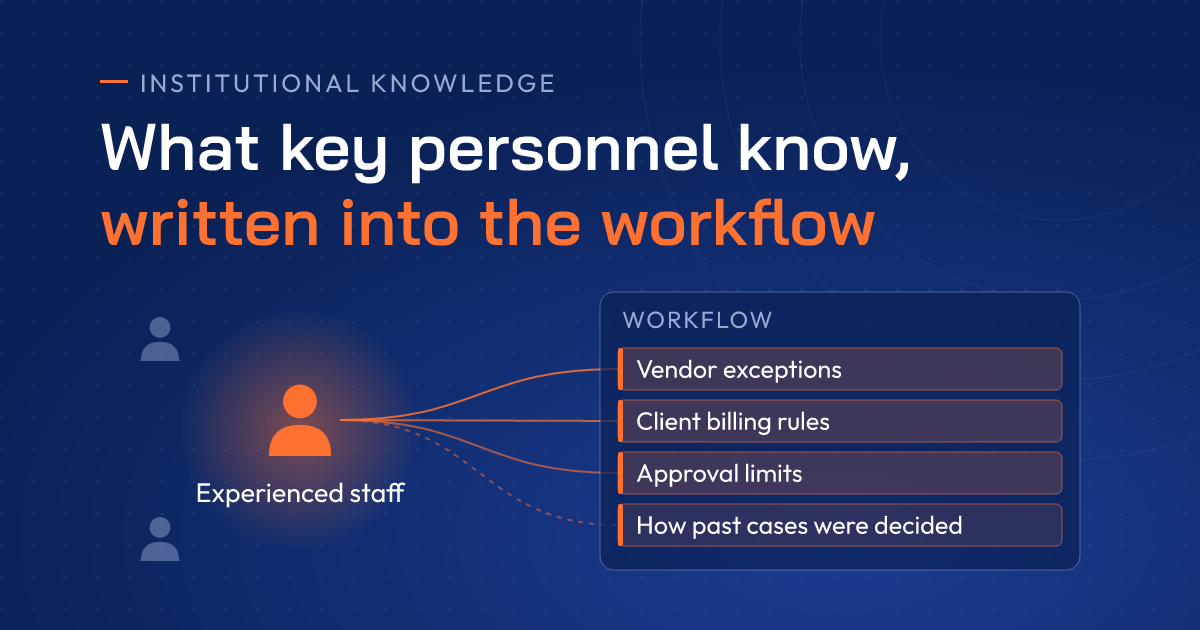
In our implementations, rules like these are seldom written down: a vendor whose invoices always need a manual adjustment, a client whose billing guidelines override the standard ones, a regulator’s informal expectation that shapes how a complaint gets answered. Key personnel apply them from memory, and the process works because those people are there.
The philosopher Michael Polanyi described this as tacit knowledge: “we can know more than we can tell.”1 Ikujiro Nonaka and Hirotaka Takeuchi later argued that organizations create durable knowledge by converting what individuals know tacitly into explicit forms that others can use.2 Until that conversion happens, the knowledge belongs to the person, and it leaves when they do.
David DeLong, who studied knowledge loss as experienced workers retire, argued that many organizations do not know what knowledge they are losing as those workers leave.3 Two decades later the gap remains. In APQC’s 2025 survey of about 1,000 professionals, more than four in five C-suite leaders said they were concerned about losing knowledge as employees retire, but only 8% of organizations consistently capture that knowledge.4
Software engineers measure this risk with the “bus factor”: the number of people who would have to leave before a project stalls. In many business processes we have mapped, the bus factor comes down to a few key personnel.
AI Use Can Erode the Skills Needed to Check AI
Our article “Faster AI at One Step Moves the Bottleneck Downstream” covered what Lisanne Bainbridge called the ironies of automation. When a system handles routine cases, the people left to handle exceptions get less practice, so they are least prepared at the moments their skill matters most.5
A 2025 observational study of 19 experienced endoscopists at four centers in Poland found an early sign of this. After they began using an AI tool that flags polyps during colonoscopy, their adenoma detection rate in procedures done without the tool fell from 28.4% in the three months before the tool arrived to 22.4% in the three months after.6
Skills may also fail to form in the first place. In a 2026 randomized trial by Anthropic researchers, not yet peer-reviewed, 52 mostly junior developers learned a new programming library; those using an AI assistant averaged 50% on a comprehension quiz against 67% for those who worked without it, and they were not significantly faster.7 In a small breakdown of the results, participants who asked the assistant to explain its code scored better than those who mainly had it write or debug code for them.
Both studies have limits. The colonoscopy study is observational and could not rule out other changes during the study period, such as a rise in procedure volume, and the quiz was taken right after the task. They still suggest that, as AI use grows, fewer people may build the practiced judgment that experienced staff have today.
AI can also help in the other direction. In a study of 5,172 customer support agents, an AI assistant raised the productivity of newer agents most, and the authors suggest such systems “may be capable of capturing and disseminating the behaviors of the most productive agents.”8 That only works if what the experienced staff know is captured somewhere the AI and the team can use it.
The Efficiency Trap: Cutting the People Who Hold the Knowledge
An AI tool speeds up a team’s routine work, the team looks overstaffed, and leadership reduces it. The people who leave can include experienced staff, whose higher salaries make them tempting targets. Hiring of junior staff, who would become the next experts, also slows: Stanford researchers found that since late 2022, employment of 22- to 25-year-olds in the most AI-exposed occupations has fallen relative to older workers.9
The routine work keeps running without them. What leaves is the ability to handle unusual cases, to catch the AI’s mistakes, and to explain why each rule exists.
The evidence suggests many organizations have fallen into this trap. In Orgvue’s 2025 survey of 1,000 senior leaders at medium and large organizations, 39% had made employees redundant as a result of deploying AI, and 55% of those said they had made wrong decisions about those redundancies.10 In an Orgvue survey of 300 US HR managers, published in March 2026, 32% of organizations that made redundancies on the cost-saving promise of AI had to rehire staff, and 23% of companies that made layoffs said they based their decisions on general assumptions about AI’s capabilities rather than an analysis of specific roles.11
The cuts also do not appear to translate into returns. In a Gartner survey of 350 executives at organizations with at least $1 billion in revenue, conducted in the third quarter of 2025, about 80% of organizations piloting or deploying autonomous business capabilities reported workforce reductions, and reduction rates were nearly equal at companies reporting higher returns and at those with modest gains or negative outcomes.12 Gartner’s analyst concluded that the organizations improving returns are those “aggressively investing more in skills, roles and operating models that allow humans to guide and scale autonomous systems.”
Specific cases show how quickly this can happen. In July 2025, Commonwealth Bank of Australia (CBA) told 45 customer service staff their roles would go after it introduced an AI voice bot. In August it reversed the decision and called it an error, saying its initial assessment “did not adequately consider all relevant business considerations.”13
The reversal followed a challenge by the Finance Sector Union at the Fair Work Commission, which disputed the bank’s claim that the bot had reduced call volumes.13 CBA has continued to adopt AI since. In July 2026 it cut hundreds of outsourced call-centre contractor roles after expanding AI in its customer chat service.14
Klarna shows the quality side of the trap. It stopped hiring for over a year while it built up its AI capabilities, and in May 2025 its CEO told Bloomberg: “As cost unfortunately seems to have been a too predominant evaluation factor when organizing this, what you end up having is lower quality.”15 Klarna then began recruiting its own customer service agents so customers could always reach a person, while remaining committed to AI.
Forrester predicted that in 2026 about half of AI-attributed layoffs would be quietly reversed, with the jobs returning offshore or at lower wages.16 Rehiring may not bring the knowledge back. The people hired may be new to the work, and those who return may have been away from it for months.
Capture the Knowledge Sooner Rather Than Later
The best time to write down what experienced staff know is while they are still doing the work and before the team changes. These are the steps we follow when we build a workflow with a customer’s team.
Find who holds the knowledge. For each process, ask who handles the cases the procedure does not cover and who others go to when something looks wrong. If the answer is one person, that process is at risk.
Treat implementation as discovery. Building an AI workflow forces each rule to be stated precisely, because a workflow cannot apply a rule nobody has written down. Most of the undocumented rules we find surface during this step, when experienced staff walk through real cases and explain why each one was handled the way it was.
Write the rules where they are applied. A rule in a procedure manual can drift away from what the team actually does. A rule written into the workflow is applied to every case, so the written version and the practice stay the same.
Check the rules for gaps and conflicts. Knowledge gathered from several people will contain rules that overlap or contradict each other. Find those before the workflow applies them, while the people who can resolve them are still available.
Give every rule an owner. Captured rules go stale when the business, a regulation or a client changes. Each rule needs a named person or role who reviews it and approves changes.
Keep a record of how cases were decided. Some judgment cannot be fully written as rules, as Polanyi observed. A log of past decisions, with the documents and reasons behind them, gives the next person examples to learn from.
Keep people practicing. Captured rules do not replace experience. Keep experienced reviewers working some routine cases, and keep hiring and training people who will become the next experts.
What an AI Workflow Needs to Hold Knowledge
When an AI model decides a case without stated rules, the business’s knowledge stays implicit in prompts and model behavior that few people can review. A workflow that holds knowledge for the long term needs four properties.
Readable rules. Business rules are kept in a form people can read, separate from the AI model, so a reviewer or auditor can see what each rule is and why it applies.
A decision record. Each decision is recorded with its inputs, the rules applied and the approvals given, so past cases can be reviewed.
Versioned rules. Each change can be traced to when it was made and who approved it.
Tested changes. Changes are tested before they go live, so updating one rule does not break another.
How Arrow AIM and Arrow TRUE Help
When we build an Arrow AIM workflow, we work through the process with the people who run it, including the exceptions and the reasons behind them. Their rules, exceptions and approval steps are written into the workflow’s configuration, where they are applied to every case. We currently build and update every workflow for our customers, and when a rule changes we update it and test the change before it goes live.
Every run is logged step by step: the documents used, the rules applied, the approvals given, and when each step started and finished. That log is a record of how cases were decided, which new staff and auditors can review after the people who made the original calls have moved on.
Arrow TRUE checks business rules for gaps and conflicts with a deterministic engine before any AI system is tested against them. Rules gathered from several experienced people are where those gaps and conflicts tend to appear, so this step matters most when knowledge is being captured for the first time.
If your team is starting to use AI, a Workflow Walkthrough goes through one of your processes with our team, including the rules that live only in people’s heads. The Workflow Library shows workflows we have built.
References
-
Polanyi, M. (1966). The Tacit Dimension. Doubleday.
-
Nonaka, I., & Takeuchi, H. (1995). The Knowledge-Creating Company: How Japanese Companies Create the Dynamics of Innovation. Oxford University Press.
-
DeLong, D. W. (2004). Lost Knowledge: Confronting the Threat of an Aging Workforce. Oxford University Press.
-
APQC (September 30, 2025). Navigating the Great Retirement with KM & AI. Survey sponsored by eGain. https://www.apqc.org/resource-library/resource/navigating-great-retirement-km-ai/html
-
Bainbridge, L. (1983). Ironies of automation. Automatica, 19(6), 775–779. https://doi.org/10.1016/0005-1098(83)90046-8
-
Budzyń, K., Romańczyk, M., Kitala, D., et al. (2025). Endoscopist deskilling risk after exposure to artificial intelligence in colonoscopy: a multicentre, observational study. The Lancet Gastroenterology & Hepatology, 10(10), 896–903. https://doi.org/10.1016/S2468-1253(25)00133-5. PubMed: https://pubmed.ncbi.nlm.nih.gov/40816301/
-
Shen, J. H., & Tamkin, A. (January 29, 2026). “How AI assistance impacts the formation of coding skills.” Anthropic. https://www.anthropic.com/research/AI-assistance-coding-skills. Paper (preprint): “How AI Impacts Skill Formation,” arXiv:2601.20245. https://arxiv.org/abs/2601.20245
-
Brynjolfsson, E., Li, D., & Raymond, L. (2025). Generative AI at Work. The Quarterly Journal of Economics, 140(2), 889–942. https://doi.org/10.1093/qje/qjae044. Free version: https://arxiv.org/abs/2304.11771
-
Brynjolfsson, E., Chandar, B., & Chen, R. (2025). Canaries in the Coal Mine? Six Facts about the Recent Employment Effects of Artificial Intelligence. Stanford Digital Economy Lab working paper (revised November 2025). https://digitaleconomy.stanford.edu/publications/canaries-in-the-coal-mine
-
Orgvue (April 29, 2025). “55% of businesses admit wrong decisions in making employees redundant when bringing AI into the workforce.” https://www.orgvue.com/news/55-of-businesses-admit-wrong-decisions-in-making-employees-redundant-when-bringing-ai-into-the-workforce/
-
Orgvue (March 12, 2026). “New research exposes the complexity of deploying AI systems in the workforce.” Survey of 300 US HR managers with Watermelon Research, conducted September 11–25, 2025. https://www.orgvue.com/news/new-research-exposes-the-complexity-of-deploying-ai-systemsin-the-workforce/
-
Gartner (May 5, 2026). “Gartner Says Autonomous Business and AI Layoffs May Create Budget Room, but Do Not Deliver Returns.” https://www.gartner.com/en/newsroom/press-releases/2026-05-05-gartner-says-autonomous-business-and-artificial-intelligence-layoffs-may-create-budget-room-but-do-not-deliver-returns
-
ACS Information Age (August 21, 2025). “CBA reverses AI-driven job cuts, admits ‘error’.” https://ia.acs.org.au/article/2025/cba-reverses-ai-driven-job-cuts—admits—error-.html. See also Bloomberg (August 21, 2025), “Australia’s Biggest Bank Reverses Plan to Replace Jobs With AI.” https://www.bloomberg.com/news/articles/2025-08-21/commonwealth-bank-reverses-job-cuts-decision-over-ai-chatbots, and Staffing Industry Analysts, “Australia’s biggest bank reverses plan to replace jobs with AI.” https://www.staffingindustry.com/news/global-daily-news/australias-biggest-bank-reverses-plan-to-replace-jobs-with-ai
-
HCA Magazine (July 2026). “CBA axes contractor call centre jobs after AI rollout.” https://www.hcamag.com/au/specialisation/hr-technology/cba-axes-contractor-call-centre-jobs-after-ai-rollout/584060
-
Daly, C. (May 8, 2025). “Klarna Slows AI-Driven Job Cuts With Call for Real People.” Bloomberg. https://www.bloomberg.com/news/articles/2025-05-08/klarna-turns-from-ai-to-real-person-customer-service
-
Summers, B. (November 12, 2025). “Future Of Work Predictions 2026: What’s Coming For Work And The Workforce.” Forrester. https://www.forrester.com/blogs/future-of-work-predictions-2026-whats-coming-for-work-and-the-workforce/. Also reported by The Register, October 29, 2025: https://www.theregister.com/software/2025/10/29/ai-layoffs-to-backfire-half-quietly-rehired-at-lower-pay/937713