Key Takeaways
- AI risk reaches insurers through vendors that sell AI systems and businesses that use them, both already covered by Tech E&O, cyber, D&O and liability policies.
- AI-related securities class actions are rising: 16 in 2025 on Cornerstone Research's count, and 32 in 2026 by November 23 on the D&O Diary's.
- Generative AI exclusions are spreading in general liability, but as AI spreads into more products, an exclusion broad enough to remove it removes a growing share of the cover.
- Insurers and reinsurers say AI risk must be measured before it can be priced.
- Many insureds share the same few models, so one fault can produce claims across a book. Failure rates for each scenario separate common-cause errors, which accumulate, from independent errors, which do not.
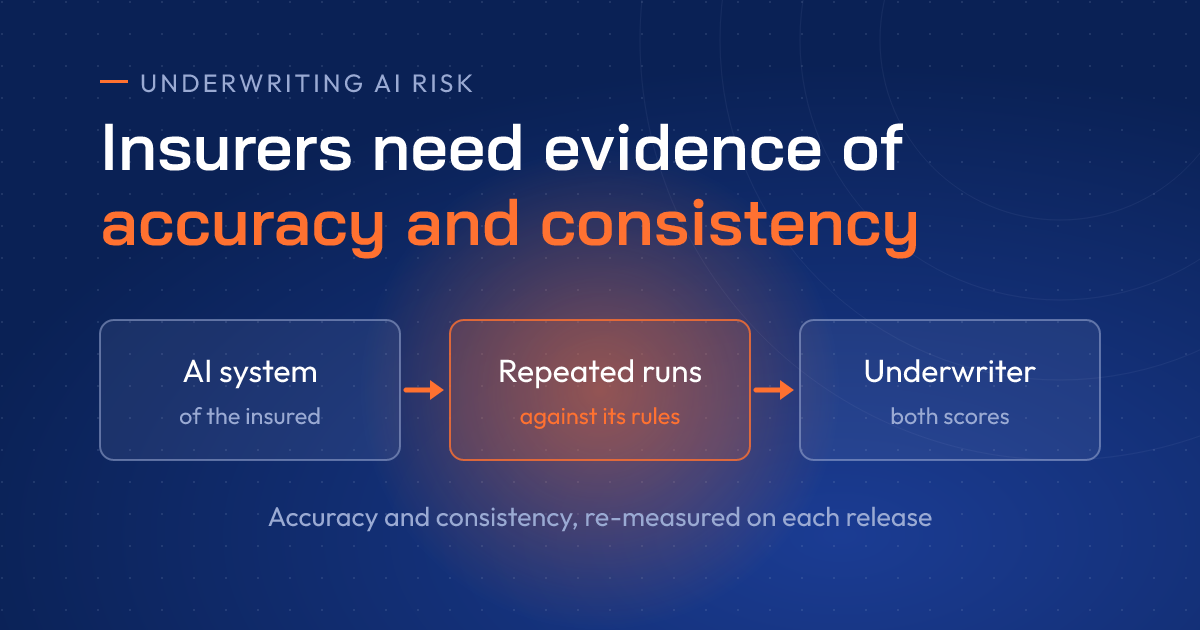
- Accuracy and consistency, tested against the insured's own rules in the developer's build process and re-tested on each release, give underwriters that evidence.
Insurers already cover the companies that build and use AI systems. Software vendors buy Tech E&O and cyber cover, their directors are covered by D&O policies, and the businesses that use their products buy liability, cyber and D&O cover of their own. As AI becomes part of more of those products and processes, it becomes part of the risk behind each of those policies.
This article is written for Cyber MGAs and for Tech E&O, D&O and liability insurers assessing the AI systems of the companies they insure. It sets out where AI risk enters existing lines, why exclusions cannot remove it, and what evidence underwriters can ask for.
The framework we propose is the one from our article on consistency in AI testing: measure how often an AI system is right, and how often it gives the same answer to the same input.
Two Kinds of Insured Carry AI Risk
The first kind is the vendor that deploys AI to its own customers. This includes software companies adding AI features to their products and newer AI-native vendors whose product is the AI system. When a vendor’s AI system makes an error, the error reaches every customer using that system.
The second kind is the business that uses AI systems. Some buy them from vendors and some build their own, and in both cases the business answers to its own customers, regulators and shareholders for what the system does.
Insurers already underwrite both kinds of insured through standard structures. What changes with AI is that the system’s output is stochastic. The same input can produce a different output on another run, so a system that passed a test last month can fail the same test today with nothing changed.
AI Risk Already Reaches Each Line of Cover
AI use is spreading among the companies insurers cover. The US Census Bureau’s business survey found that national AI use hovered between 17% and 20% of firms from December 2025 to May 2026. In the latest data, use was 33.9% in finance and insurance, against 19.8% nationally, and 37% among firms with at least 250 employees.1 AI use is highest among larger firms, which are also the insureds buying the largest limits.
Tech E&O. Vendors are already facing claims over what their AI systems do for customers. In Mobley v. Workday, a federal court let the claims proceed in July 2024, with the plaintiff arguing that the vendor of the AI screening software is liable as an agent of the employers that used it, and in May 2025 it conditionally certified an age-discrimination collective action. As of late 2026 there has been no ruling on the merits.2 Even without a merits ruling, the case shows that an AI vendor can be pulled into claims over decisions its customers made with its software, which is the exposure a Tech E&O policy is written for.
Cyber. Coalition added an affirmative AI endorsement to its cyber policies in March 2024. It expands the definition of a security failure or data breach to include an “AI security event,” and the funds transfer fraud trigger to include instructions sent through deepfakes.3
In September 2026 Beazley added an AI Clarifying Endorsement which, as Insurance Business reported, confirms that AI-driven cyber attacks “fall within its existing full spectrum cyber cover.”4 Alessandro Lezzi, Beazley’s Group Head of Cyber Risks, said that “Insurance policies should not add to this uncertainty.”5 When carriers write wording to confirm that AI events are covered, they are treating AI as part of the cyber risk they already carry.
Underwriters are also asking more about AI use. Lockton reported in July 2026 that “some carriers are beginning to ask increasingly granular questions about how AI is used.”6
D&O. AI is now a regular subject of securities litigation. Cornerstone Research and the Stanford Securities Class Action Clearinghouse counted 16 AI-related securities class actions in 2025 and 15 in the first half of 2026, which was on pace to nearly double the 2025 total.7
Those 15 filings accounted for 73% of the disclosure dollar loss of all filings in that period, a measure of alleged market-value losses, not of settlements.7 The D&O Diary counted 32 AI-related securities class actions filed in 2026 by November 23.8 The two counts use different methods, but both show the number rising.
The share of losses matters more than the count. Joseph Grundfest, a Stanford law professor and former SEC commissioner, said that “AI-related cases represented a modest share of total filings but an outsized share of alleged investor losses in the first half of 2026.”7 Few cases carrying large alleged losses is the profile D&O underwriters have the most reason to price carefully.
Regulators have acted on claims about AI as well. In March 2024 the SEC settled charges against two investment advisers, Delphia and Global Predictions, for misleading statements about their use of AI, with penalties totaling $400,000.9 Aon reported in October 2026 that it had not seen insurers try to add AI-specific exclusions to D&O policies, and that at least four derivative suits over AI oversight were pending against technology companies.10
General liability. Commercial general liability responds to bodily injury, property damage and personal and advertising injury, so most claims over wrong AI outputs fall under E&O instead. Even so, general liability is where exclusions have spread fastest, which we turn to below.
Allianz Commercial has warned that the small number of confirmed AI claims understates the exposure. Its CEO, Thomas Lillelund, said that “Today’s apparently modest number of confirmed AI claims hides the true extent of exposures for businesses.”11
Taken together, the evidence from all four lines points the same way. AI is already producing claims, new cover and new underwriting questions inside existing policies, so an insurer writing any of these lines is exposed to AI risk whether or not its wording mentions AI.
One Model Error Can Reach Many Policyholders
AI also changes how losses accumulate. Menlo Ventures, an investor in Anthropic, estimated that Anthropic, OpenAI and Google together took 88% of enterprise spending on large language model APIs in 2025, at 40%, 27% and 21%, from a survey of US enterprises.12 With so many businesses building on the same few models and buying from the same AI vendors, a single fault can produce claims from many insureds at the same time.
Insurance Business, reporting on Gallagher Re’s March 2026 white paper, said flaws in widely used AI models “may generate correlated losses across sectors and geographies.”13 Global Reinsurance, summarizing Swiss Re Institute research, pointed to “the potential for accumulation across cyber, liability and business interruption lines.”14
RAND’s September 2026 report on the insurability of AI recommended that “Insurers and reinsurers should analyze AI aggregation scenarios, focusing on shared model dependency.”15 Kevin Kalinich of Aon gave a wider warning to a US Senate subcommittee in July 2025: if AI-induced dislocation became systemic, triggering job losses, market volatility and “cascading liability claims,” insurers “may find themselves facing unquantifiable aggregate exposures,” and “These correlated risks are difficult to price, underwrite, and reinsure using existing structures.”16
These sources come from different parts of the market, a reinsurance broker, a reinsurer’s research, an independent research organization and an insurance broker testifying to the Senate, and they point to the same underlying problem of correlation. AI failures do not stay with one policyholder, and that is the condition under which pricing each risk on its own stops working. For an insurer’s book as a whole, accumulation is the AI risk with the most consequence.
Exclusions Are Spreading, and They Have Limits
Verisk introduced optional endorsements with a January 2026 edition date that exclude generative AI from commercial general liability cover.17 W. R. Berkley introduced an exclusion for D&O, E&O and fiduciary policies that removes claims arising from “any actual or alleged use, deployment, or development of Artificial Intelligence.”18
Adoption has been fast. A review of state insurance filings by Trades Coverage, which is operated by a licensed insurance producer selling cover to contractors, found 4,078 filed adoptions of generative AI exclusion forms across 49 states and the District of Columbia. By July 31, 2026, 2,369 had reached their effective dates.19 The review counts one adoption for each carrier or program, form and state, which is different from a count of policies.
Thousands of adoptions within seven months of the forms’ January 2026 edition date show that carriers are preparing to exclude generative AI in general liability, though a filing does not show that an exclusion was attached to any policy. Most policies have not changed yet: RAND found that “Most carriers are remaining silent, neither affirming nor excluding AI-related risks in their policies.”15 The direction of travel is still toward exclusion, which is why its limits matter.
Exclusions have a limit, and it grows with AI adoption. As AI becomes part of more software products and business processes, an exclusion broad enough to remove AI will remove a growing share of the cover the insured is buying. A Tech E&O policy that excludes the vendor’s AI features may exclude a growing share of the product’s risk. Kalinich told the Senate that some carriers insert “narrowly-scoped sublimits” for AI instead of exclusions; those restore some cover only up to a limit, which still has to be priced.16
Some in the market are already making this argument. An insurance lawyer told Insurance Journal in August 2026 that insurers may “choose to underwrite and price the risks probably for an additional premium rather than exclude them,” and that “Aggressive exclusions may make their policies less attractive.”20
Pricing AI Risk Requires Measured Performance
To price AI risk, insurers need data on how AI systems behave, and that data is scarce. The Geneva Association found that “Limited loss data and asymmetric information further complicate the insurability of Gen AI risks,” and that “Insurers may struggle to verify Gen AI risks and how businesses manage them.”21
Gallagher Re’s Ed Pocock put the consequence directly: “If a model cannot be independently evaluated, it cannot be meaningfully priced.” He said benchmarks “indicate what a model can do under controlled conditions,” while insurers are concerned with “how models fail, how often they fail.”22
Without independent evaluation, Pocock added, insurers could end up loading for uncertainty rather than pricing the actual risk, which raises costs for everyone. The report also calls for testing over time as models are updated.22
Some cover is already priced this way. Munich Re’s aiSure states that “The quality of the model and its performance stability determine the premium,” and that “Based on historical performance data, we can estimate the future likelihood of model underperformance.”23 Mosaic offers cover in partnership with aiSure that pays out when an AI system misses an accuracy target agreed in advance.24
Underwriters also reward documented controls. In his Senate testimony, Kalinich said new AI endorsements typically involve additional premium “tied to the presence of documented governance controls, such as validation protocols, audit trails, bias mitigation efforts, and explainability metrics,” and that “Where these controls are strong, underwriters are more willing to extend broader terms.”16
An insurance industry research body, a reinsurance broker, a reinsurer and a broker’s Senate testimony all reach the same conclusion: AI risk can be priced only as well as it can be measured. Munich Re’s product is the strongest of these pieces of evidence, because it shows measured performance already being used to set a premium.
Accuracy and Consistency Give Underwriters a Measure
The framework in our article on consistency uses two figures, each measured by running every test scenario many times:
- Accuracy is how often the system’s answer is right.
- Consistency is how often the system gives the same answer to the same input.
Each figure answers a different underwriting question. Accuracy shows how often a system is likely to produce an error, which relates to claim frequency. Consistency shows how predictable those errors are, which is one part of what Munich Re calls performance stability; re-testing across releases covers the other part, stability over time.
Repeated runs also show how much each figure is worth. Ten clean runs of a scenario are consistent with a failure rate as high as about 26%, while 100 clean runs bring that bound down to about 3%. Reporting each score with a confidence interval tells the underwriter how much weight the number can bear.
The tests also have to be built on the right answers. For an insured, those are its business rules: what its contracts, policies and regulators require the system to do. The rules should be checked for gaps and conflicts before the system is tested, because a gap in the rules is a gap in what the insured has promised.
An underwriter assessing an insured’s AI system could ask:
- Which AI systems make or influence decisions, and which business rules govern them?
- What are their accuracy and consistency on repeated runs against those rules, with confidence intervals?
- Were the rules checked for gaps and conflicts before testing?
- How often are the systems re-tested, and are the results of each release kept?
Consistency Separates Independent Errors From Common-Cause Errors
Insurers already distinguish risk that diversifies across a book from risk that accumulates. In our view, AI errors divide the same way, and consistency is the measure that tells the two apart.
Independent errors happen on some runs and not on others. Which case fails varies from one call to the next, so across many insureds the failures behave much like independent events, and while the system stays unchanged, the total loss settles around a predictable rate. A risk of this kind can be priced from that rate.
Common-cause errors happen every time on a particular kind of case. Users of the system who meet that kind of case get a wrong answer every time. When many insureds rely on the same system or model, these errors accumulate across a book. Within a single insured they behave more like a serial loss, many claims from one cause, which related-claims wording may tie to a single limit; across a book, nothing caps it. Either way, a repeatable error is easier to trace and correct once it is measured.
Accuracy alone cannot separate the two. A system that is 95% accurate might be wrong on a random 5% of runs, or wrong every time on 5% of the kinds of case it handles. The accuracy is the same, but the first is mostly an expected-loss question and the second is a question of serial or accumulated loss. The consistency score shows which one an underwriter is looking at.
Repeated testing also shows which kind of error a system has. If one scenario fails on every run, or nearly every run, the error has a common cause, and customers running the same configuration are likely to get a wrong answer on that kind of case every time. If failures are spread thinly across many scenarios, each failing on a few runs, the errors are mostly independent.
Two systems with the same overall accuracy can therefore have very different failure rates scenario by scenario, and so very different accumulation profiles. Only results scenario by scenario, with enough runs of each to tell a scenario that fails often from one that fails only a few times, show which one an underwriter is looking at.
The Testing Has to Run Where the Software Is Built
AI systems change often. Vendors update models, prompts and rules between releases, and AI coding tools are raising the volume of software change, as we described in our article on change risk.
A measurement taken once a year at renewal describes a system that may no longer exist by mid-term. Testing that keeps pace has to run in the developer’s own build and release process, so that each change is measured before it ships.
That is a demanding kind of testing, and it is more than a benchmark or a one-off audit. It needs software development kits (SDKs) that let developers connect their AI systems to the tests, and support for continuous integration (CI), the automated process that builds and checks software on every change. It also needs test scenarios generated from the insured’s rules, many runs of each scenario, and statistics that turn the results into scores with confidence intervals.
Measured this way, accuracy and consistency against the insured’s own rules, repeated on each release, give an underwriter evidence about how a specific system behaves, which loss data and questionnaires cannot provide on their own. These are results the insured or its vendor produces, so they are strongest when the underwriter can see the scenarios and runs behind the scores.
Testing in the developer’s build process also helps with correlated risk in two ways.
- It measures the risk where it concentrates. When the tests run in a vendor’s release process, they measure the system that every one of that vendor’s customers relies on. One set of results then speaks to many downstream insureds, including the common-cause errors they would all share.
- It shows a shared model change as it reaches each system. Model providers let developers pin a specific version; Anthropic, for example, states that “Every Claude model ID is a pinned snapshot.” Systems that call an unpinned alias instead follow the provider’s updates automatically.25 A new model version therefore reaches each system as its developers move to it, and many move within the same window when an old version is retired. That shared move is what a correlated event looks like. Re-running the same scenarios on each release and on a regular schedule, which also catches a system on an unpinned alias that changes without a release, with a record of which model and version each run used, shows the effect of the change when it reaches each system. An annual audit would see it at the next renewal, and loss data would see it only after claims were filed.
How Arrow TRUE Supports Underwriting
Arrow TRUE is one example of this kind of testing. We have developed SDKs that let a vendor’s engineers connect their AI system to TRUE, and TRUE runs as a step in their CI pipeline, so each release is tested before it ships. A business that builds its own AI system can run the same tests, and a business that buys one can ask its vendor for the results.
TRUE starts with the insured’s business rules. A deterministic automated-reasoning engine, which is not a language model, checks them for gaps and conflicts. TRUE then generates synthetic test scenarios from the validated rules, so no production data is needed, and the AI system answers each scenario many times.
TRUE reports accuracy and consistency with 95% confidence intervals and traces each inconsistency to the AI system or to a gap in the rules. It also reports the failure rate for each scenario, so an underwriter can see whether a system’s errors are concentrated on a few kinds of case or spread thinly across many. Because the scenarios are generated from the business rules, a concentrated failure points to the rule, and so the obligation to customers, that is at risk. Each run is recorded with the underlying model and version it used, so results from one release can be compared with the next. An underwriter can see whether a system has changed since the last renewal and, when the tests are re-run after a model change, whether that change has moved its accuracy or consistency.
TRUE measures whether a system follows the rules it is tested against. Whether those rules are the right ones stays with the insured, and TRUE does not replace security testing or the insurer’s own underwriting judgment.
If you underwrite companies that build or use AI systems, a TRUE Assessment of an insured’s AI system shows what these results look like in practice. We would also welcome a conversation about how measured results could fit into your applications and renewals.
References
-
US Census Bureau (May 26, 2026). Story on AI use by businesses, from the Business Trends and Outlook Survey. https://census.gov/library/stories/2026/05/ai-use-businesses.html
-
“AI Bias Lawsuit Against Workday Reaches Next Stage as Court Grants Conditional Certification of ADEA Claim.” Proskauer Rose LLP, Law and the Workplace blog (June 11, 2025). Law-firm summary of Mobley v. Workday, Inc., N.D. Cal. https://www.proskauer.com/blog/ai-bias-lawsuit-against-workday-reaches-next-stage-as-court-grants-conditional-certification-of-adea-claim
-
Coalition (March 26, 2024). “Coalition Adds New Affirmative Artificial Intelligence Endorsement to Cyber Insurance Policies.” https://www.coalitioninc.com/announcements/coalition-adds-new-affirmative-ai-endorsement-to-cyber-policies
-
Rosanes, M. (September 17, 2026). “What Beazley’s AI cyber endorsement does and doesn’t cover.” Insurance Business. https://www.insurancebusinessmag.com/us/news/cyber/what-beazleys-ai-cyber-endorsement-does-and-doesnt-cover-590125.aspx
-
Jimenez-Sanchez, K. (September 17, 2026). “Beazley adds affirmative AI cover in cyber and tech E&O policies.” Reinsurance News. https://www.reinsurancene.ws/beazley-adds-affirmative-ai-cover-in-cyber-and-tech-eo-policies/
-
Lockton (July 2026). “Managing risk in a new technology.” Spotlight: AI, Lockton Market Update. https://insights.lockton.com/lockton-market-update/july-2026/spotlight-ai
-
Cornerstone Research (January 28, 2026). “Overall Size of Securities Class Action Filings Reached New Heights in 2025.” https://www.cornerstone.com/insights/press-releases/overall-size-of-securities-class-action-filings-reached-new-heights-in-2025/. Cornerstone Research (July 29, 2026). “Securities Class Action Filings Surge in the First Half of 2026.” https://www.cornerstone.com/insights/press-releases/securities-class-action-filings-surge-in-the-first-half-of-2026/
-
Abrams, S. (November 23, 2026). “AI-Related Litigation Trend Grows with Recent Securities Suits and Derivative Actions.” The D&O Diary. https://www.dandodiary.com/2026/11/articles/artificial-intelligence/ai-related-litigation-trend-grows-with-recent-securities-suits-and-derivative-actions/
-
US Securities and Exchange Commission (March 18, 2024). Press release 2024-36 on charges against Delphia (USA) Inc. and Global Predictions Inc. https://www.sec.gov/newsroom/press-releases/2024-36
-
Furmansky, A., Reider, N., & Wanlass, L. (October 5, 2026). “AI-Related D&O Claims and Emerging Litigation Risks.” Aon. https://www.aon.com/en/insights/articles/ai-related-do-claims-and-emerging-litigation-risks
-
Rosanes, M. (November 19, 2026). “AI losses are hiding inside existing policies, Allianz Commercial warns.” Insurance Business. https://www.insurancebusinessmag.com/us/news/technology/ai-losses-are-hiding-inside-existing-policies-allianz-commercial-warns-598043.aspx
-
Tully, T., Redfern, J., Das, D., & Xiao, D. (December 9, 2025). “2025: The State of Generative AI in the Enterprise.” Menlo Ventures. https://menlovc.com/perspective/2025-the-state-of-generative-ai-in-the-enterprise/
-
Bolivar, R. (March 25, 2026). “Gallagher Re identifies systemic risk from AI model failures.” Insurance Business. Report on Gallagher Re’s white paper Smart Systems, Blind Spots: Rethinking Insurance for the AI Era. https://insurancebusinessmag.com/reinsurance/news/breaking-news/gallagher-re-identifies-systemic-risk-from-ai-model-failures-569775.aspx
-
Global Reinsurance (January 14, 2026). “Swiss Re: AI boom reshapes risk, but leaves insurers exposed.” Summary of Swiss Re Institute research. https://www.globalreinsurance.com/home/swiss-re-ai-boom-reshapes-risk-but-leaves-insurers-exposed/1457491.article
-
Romanosky, S., & Robinson, C. (September 16, 2026). The Insurability of Artificial Intelligence (RR-A5130-1). RAND Corporation. https://www.rand.org/pubs/research_reports/RRA5130-1.html
-
Kalinich, K. (July 30, 2025). Written testimony to the Subcommittee on Securities, Insurance, and Investment, US Senate Committee on Banking, Housing, and Urban Affairs, hearing “Guardrails and Growth: AI’s Role in Capital and Insurance Markets.” https://www.banking.senate.gov/download/kalinich-testimony-7-30-25&download=1
-
Germond, N. (October 21, 2025). “Verisk to Roll Out New General Liability Exclusions for Generative AI Exposures.” Big “I” Virtual University. https://www.independentagent.com/vu_resource/verisk-to-roll-out-new-general-liability-exclusions-for-generative-ai-exposures/
-
Fehling, G. B., Levine, M. S., & Pappas, A. D. (May 28, 2025). “The Continued Proliferation of AI Exclusions.” Hunton Insurance Recovery Blog, Hunton Andrews Kurth. Law-firm source. https://www.hunton.com/hunton-insurance-recovery-blog/the-continued-proliferation-of-ai-exclusions
-
Trades Coverage (August 2026, updated August 18, 2026). “The AI exclusion hiding in your contractor insurance.” Trades Coverage is operated by Switchboard Risk Technologies Inc., a licensed insurance producer. https://tradescoverage.com/reports/genai-exclusion-adoption/
-
Jergler, D. (August 17, 2026). “Insurer Interest in AI Coverage Exclusions Growing as Risk Becomes Omnipresent.” Insurance Journal. Quotation from Alana McMullin, Lathrop GPM. https://www.insurancejournal.com/magazines/mag-features/2026/08/17/881424.htm
-
The Geneva Association (October 2025). Gen AI Risks for Businesses: Exploring the role for insurance. https://www.genevaassociation.org/sites/default/files/2026-06/gen_ai_businesses_report_2506.pdf
-
Rosanes, M. (June 11, 2026). “Insurers cannot price what they cannot evaluate, Gallagher Re warns.” Reinsurance Business (Insurance Business). https://www.insurancebusinessmag.com/reinsurance/news/breaking-news/insurers-cannot-price-what-they-cannot-evaluate-gallagher-re-warns-578579.aspx
-
Munich Re. “Frequently Asked Questions” (aiSure). https://www.munichre.com/en/solutions/for-industry-clients/insure-ai/faq.html
-
Shefchik, C. (March 6, 2026). “Insurers begin covering AI mistakes as adoption spreads.” The Royal Gazette. https://www.royalgazette.com/reinsurance/business/article/20260306/insurers-begin-covering-ai-mistakes-as-adoption-spreads/
-
Anthropic. “Models overview.” Claude Platform documentation (accessed November 2026). https://platform.claude.com/docs/en/about-claude/models/overview